AI and Computing · Frame 16 of 17
Enigma Machine
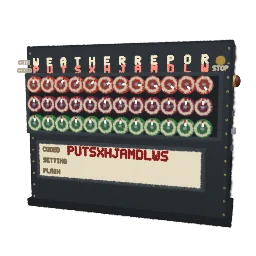
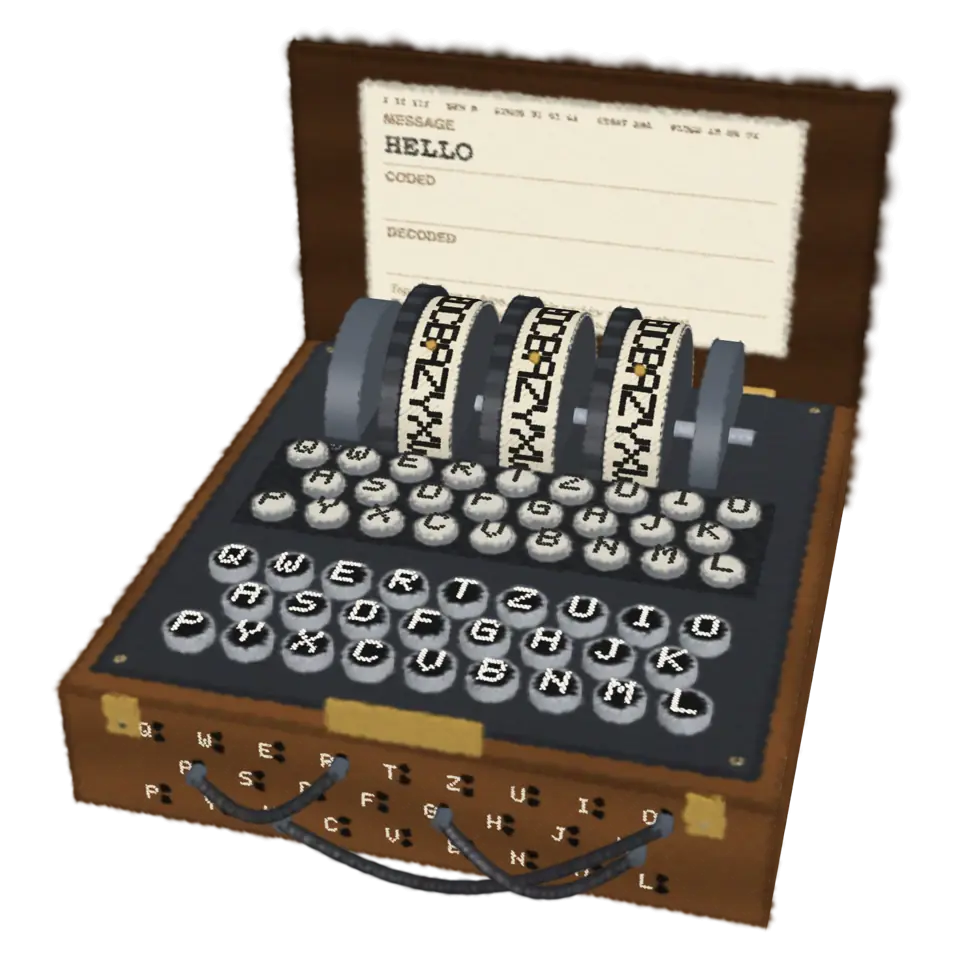
The Enigma was a cipher machine German forces used to keep radio messages secret in World War II.
The raised picture is a guess from this still. “Turn it here” is the real Splash.
- Shelf
- AI and Computing
- Kind
- Built from a recipe
- Your own
- Type your own message
- Sound
- Yes
- Hands-on
- Yes
- Licenses
- Own work (made in the page)
How to play
Tap the keys to type in code. Hands-on: drag a rotor up or down to set it.
Its controls
| Control | Kind | Range | Start |
|---|---|---|---|
| Type the message | Tap | ||
| Type it | Button | ||
| Key | Button | ||
| Clean sheet | Button | ||
| Step back | Button | ||
| Setting | List | 3 choices | Set it yourself |
| Left rotor | List | 5 choices | Rotor I |
| Middle rotor | List | 5 choices | Rotor II |
| Right rotor | List | 5 choices | Rotor III |
| Reflector | List | 2 choices | B |
| Left ring | List | 26 choices | A (01) |
| Middle ring | List | 26 choices | A (01) |
| Right ring | List | 26 choices | A (01) |
| Left start | List | 26 choices | A |
| Middle start | List | 26 choices | A |
| Right start | List | 26 choices | A |
| Plugboard | Text |
About it
The Enigma was a cipher machine German forces used to keep radio messages secret in World War II. Each key press steps the rotors, including an occasional double step, and a current runs through the plugboard, three wired rotors and a reflector, lighting a different letter. Because the rotors keep turning, the same letter comes out differently each time. Polish mathematicians first broke it in 1932.
Tap a key, or type: the rotors step (with the middle rotor's real double step) and the coded letter lights and goes on the pad. Tap the machine off the keys to decode, or to type the stored message. Tap the pad for a clean sheet; tap the rotors, or press Backspace, to take a letter back. On a keyboard, hold Shift for P and R. Set it in the Splash tab as from a key sheet: three of five rotors, reflector B or C, rings, start letters and up to ten plugboard pairs, shown on the pad. Or pick Barbarossa, 1941, and decode a real German Army message with its published key.
Details
- Splats
- Opens at 200,000 at Mid Detail, 119,378 at Low, and up to 610,000 at Max
Is it right?
The I–II–III wirings, reflector B, plugboard transformation, and double step agree with published references. Independent encryption matches all six supported rotor orders and nonzero rings in the calculation helper. The interactive splash exposes only one fixed configuration and cannot yet decode the published historical example.
Correct
Rotors I, II, III and reflector B use the historical wiring.1
The stored permutations and notch letters Q, E, V match the museum table; the independent reference uses separately written string permutations.
Correct
Stepping occurs before encryption and includes the middle rotor’s double step.23
Published double-step sequences and 384 independent 100-letter messages match every intermediate rotor position and output.
Correct
The plugboard and reflector make encryption reciprocal.2
No-plug and two nontrivial plugboards are checked across all rotor orders and nonzero rings; resetting and enciphering ciphertext recovers the input, and no letter encrypts to itself.
Correct
Polish mathematicians broke military Enigma in 1932.4
The About date agrees with Rejewski’s recovery of the wiring and subsequent Polish cryptanalysis.
Simplified
The interface represents only a fixed Enigma configuration.12
It resets to AAA with default rotors and plug pairs. Historical rotor selection, rings, plugs, and starting windows are not selectable.
Simplified
A historical message would require additional settings.35
An independent extended reference decodes KCH at WXC to BLA, then the published wartime message using II-IV-V, rings B-U-L, and ten plug pairs. IV/V exist only in the test reference.
- 1Enigma wiring, Crypto Museum
- 2How Enigma works, Crypto Museum
- 3Enigma test examples, Py-Enigma maintainer Brian Neal
- 4Enigma history, Crypto Museum
- 5Py-Enigma user guide, Py-Enigma maintainer Brian Neal
- Simplified
- The interface fixes order I–II–III, rings A–A–A, starting windows A–A–A, and plug pairs A–R, G–K, O–X. The helper supports the six I/II/III orders and rings, but those controls are not exposed. Rotors IV and V are absent. Backspace, reversing a key press, and the short pad are conveniences rather than historical machine features.
Sources and credits
Made in Splashery. Its code is MIT.